Ground Outs#
The ground out is the most common play in baseball. Batter hits a grounder, an infielder scoops it up, throws to first, and the batter is out. It happens dozens of times per game, so you’ll want this notation in your muscle memory fast.
The Notation#
A ground out is written as the fielder numbers separated by dashes, in the order the ball was handled:
6-3 — Shortstop fielded, threw to first baseman.
That’s it. The first number is who picked it up, the last number is who caught it for the out. If the ball went through more than two hands, you add the middle fielders too.
Here’s a 6-3 ground out on a hand-scored card — shortstop to first baseman, with the out number circled:

Common Ground Outs#
Here are the ground outs you’ll see most often, roughly in order of frequency:
| Notation | Description |
|---|---|
| 6-3 | Shortstop to first. The most common ground out in baseball. |
| 4-3 | Second baseman to first. |
| 5-3 | Third baseman to first. |
| 1-3 | Pitcher to first. Typically on a comebacker or bunt. |
| 3U | First baseman unassisted. He fielded it near the bag and stepped on it himself. |
| 1-6-3 | Pitcher to shortstop to first. Rare relay play. |
| 3-6-3 | First baseman to shortstop to first (1B fielded it, threw to SS covering second for a force, SS threw back to 1B for the out). You’ll sometimes see this on bunt plays or with a runner on first. |
The “U” in “3U” means unassisted — only one fielder was involved. You’ll see this when the first baseman fields a ball hit near the bag and doesn’t need to throw to anyone.
Bunt Ground Outs#
Bunts that result in outs look the same as regular ground outs in the notation — the fielder numbers tell the story. A bunt fielded by the pitcher and thrown to first is 1-3, same as any other comebacker.
If the bunt is a sacrifice (the batter bunted intentionally to advance a runner, giving themselves up), the notation adds “SAC” as a prefix: SAC 1-3 or SAC 5-3. The sacrifice designation matters for statistics — a sac bunt doesn’t count as an official at-bat, so it doesn’t hurt the batter’s average.
Ground Outs with Multiple Runners#
When there are runners on base during a ground out, the defense might throw to a different base first. A grounder to short with a runner on first might result in:
- 6-3 — Shortstop threw to first (got the batter, runner advances)
- 6-4 — Shortstop threw to second (got the lead runner, batter reaches first on a fielder’s choice)
- 6-4-3 DP — Shortstop to second to first (got both — a double play)
When the defense chooses to get the lead runner instead of the batter, that’s a fielder’s choice. When they get both runners, that’s a double play.
What About the Runners?#
The ground out notation only records the batter’s result. What happened to the other runners — did they advance? Were they thrown out? — is recorded separately through the runner’s path on the scorecard.
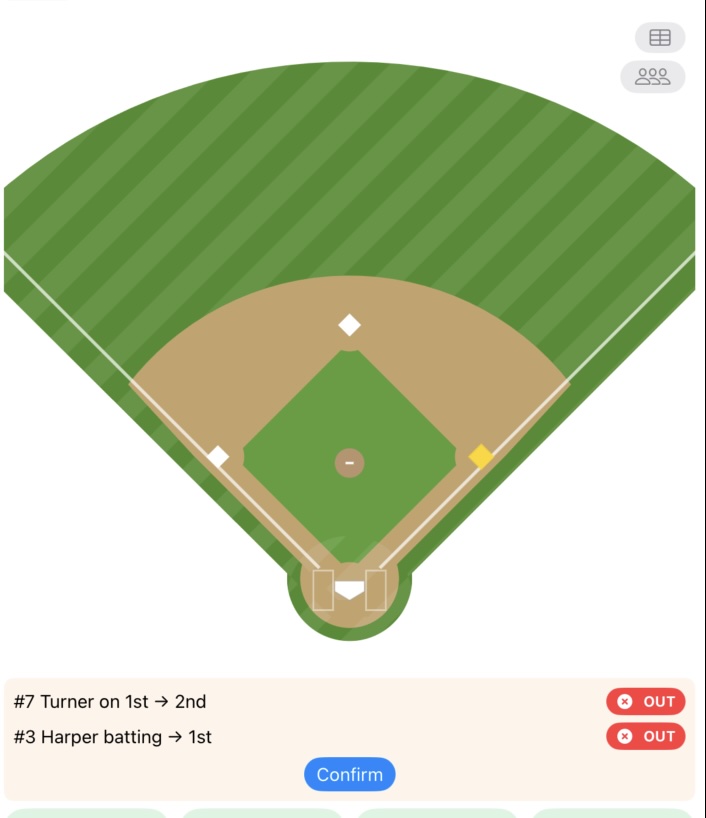
In BaseballScorer, after you record a ground out with runners on base, the app asks you what happened to each runner. Each runner’s resolution is tappable — tap it to cycle through the options:
- Out — the runner was retired on the play (the default for forced runners when the fielding sequence involves their base)
- Safe — the runner advanced safely to the next base
- Stays at base — the runner held and didn’t advance (only available when the runner isn’t forced)
- Stranded — the play resulted in the third out of the inning, so the runner is left on base
The app sets smart defaults based on the situation — forced runners with a three-fielder sequence default to Out, since that’s probably a double play — but you can tap any runner’s status to change it to match what actually happened on the field.
Errors in the Fielding Sequence#
A clean ground out is the simple case — the ball gets fielded and thrown without incident. But things go wrong: the second baseman bobbles the relay, the first baseman muffs the throw, a fielder doesn’t touch the bag. Scorekeeping has a notation for that: the “E” prefix in front of the fielder who made the error.
| Notation | What happened |
|---|---|
| 6-E4-3 | Shortstop fielded, threw to second, 2B muffed the relay (lead runner safe), 2B recovered and threw to first to retire the batter |
| 6-4-E3 | Shortstop to second (lead runner forced), 1B muffed the throw — batter reaches on the error |
| 6-E4 | Shortstop to second, 2B muffed the throw — play dies, batter reaches |
| E6 | Shortstop alone made the error — booted a routine grounder, batter reaches |
The position of the “E” in the chain tells the story. Notice the two outcomes split:
- If an error happens before the last fielder in the chain, the play might still produce an out — somebody downstream caught the ball cleanly and made the play. The batter is still out (or the lead runner is, depending on the sequence). 6-E4-3 is still a ground out — the batter was retired at first.
- If the error happens at the last fielder, the play usually dies right there. The batter reaches base on the error. 6-4-E3 is scored as an error (not a ground out) — even though everyone in the chain is the same as a clean 6-4-3 double play, the muff at the end changes the outcome.
Each fielder marked with an “E” is charged one team error on the line score, regardless of how many fielders touched the ball.
Scoring a Ground Out in BaseballScorer#
Here’s the flow:
- Tap “Ground Out” (or “GO” on compact screens) from the outcome buttons
- Tap the fielders on the diamond in the order they handled the ball — fielder position numbers appear at each position
- (Optional) Tap the “E” toggle before tapping a fielder to flag that fielder as committing an error — the button turns red, and the next fielder you tap is marked with E. The toggle auto-disarms after the tap. Repeat for additional errors in the chain.
- Tap “Complete” (or “Unassisted” if only one fielder was involved)
- Resolve runners if any were on base — toggle each runner’s fate
If you flagged the last fielder in the chain as an error, the app asks “Did the batter reach base?” — picking Yes scores the play as an error (with the chain preserved as “6-4-E3” for context), picking No keeps it as a ground out (the chain still retired the batter despite the slip-up).
Was it a great defensive play? Before tapping Complete, tap the ★ star button to mark it as a defensive gem. A gold star appears on the scorecard and inning summary — the same idea as the star or exclamation point paper scorers use to highlight spectacular plays.
The app builds the notation automatically: tap 6, tap 3, and you’ll see “6-3” appear in the batter’s completed at-bat card. With an error in the chain, the notation interleaves the E marker — “6-E4-3” — exactly as you’d write it on paper.
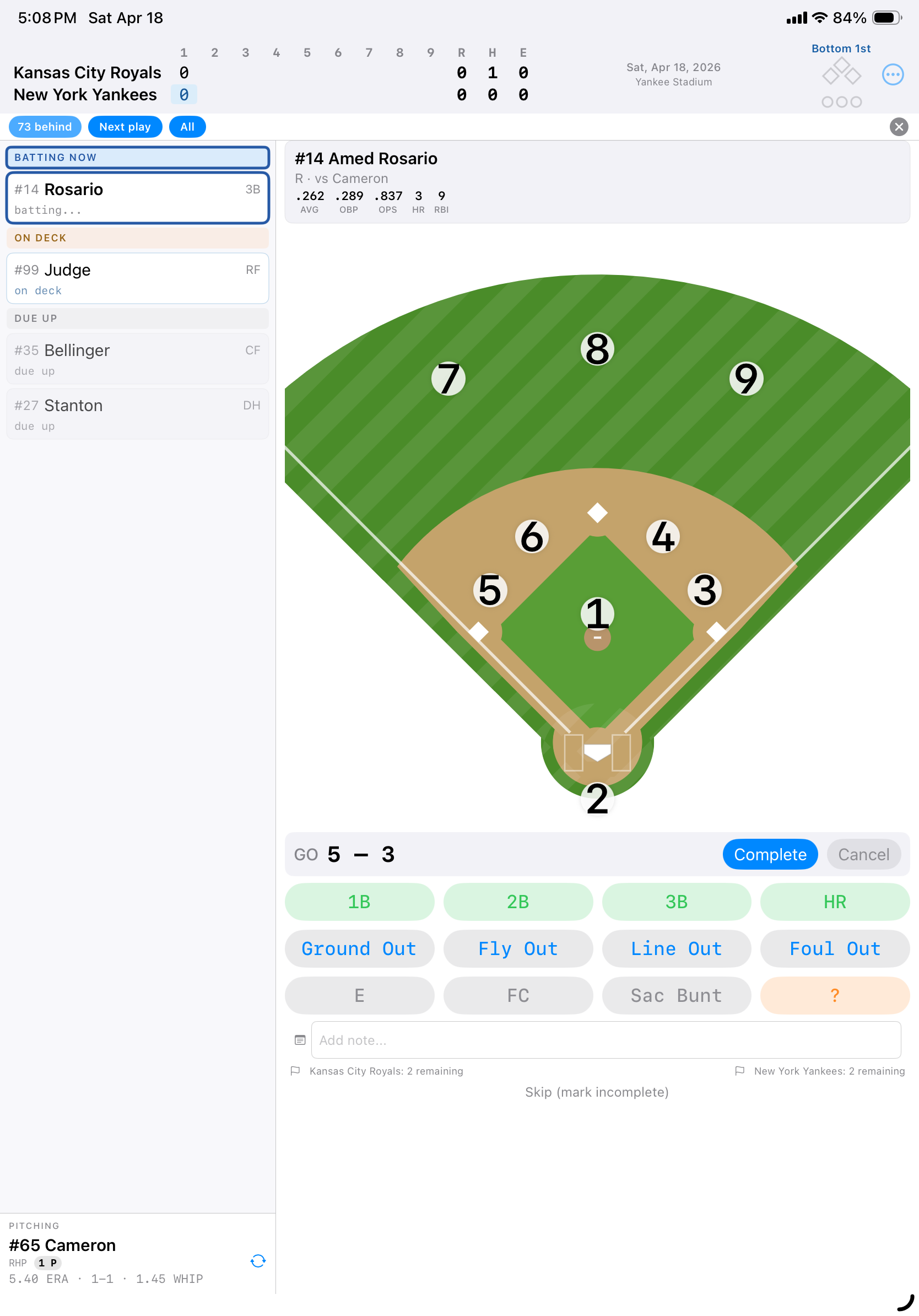
For a simple ground out with no runners on base, the whole thing takes about two seconds — tap GO, tap two fielders, done.
The Unassisted Ground Out#
The “3U” is a special case worth calling out. When the first baseman fields a grounder near the bag and steps on it himself, there’s no throw involved — he just fields and tags the base. You record this by tapping just the single fielder (3), then tapping “Unassisted” instead of “Complete.”
On paper, you’d write 3U. The “U” makes it clear that only one player was involved. Without it, a bare “3” on the scorecard would be ambiguous — did the first baseman make an unassisted out, or did someone forget to write the rest of the play?
Related#
- Double Plays — when the ground out gets two runners (coming soon)
- Fielder’s Choice — when the defense throws to a different base (coming soon)
- Sacrifice Bunts — when the batter bunts intentionally to advance a runner (coming soon)
- Fielder Position Numbers — the complete numbering reference